
Is Java Finally Dead? ☠️
If you still think Java is the same language you learned a decade ago, you are already behind.

Every year, people claim “Java is dead”. Meanwhile, it keeps shipping a new release every six months.
If you still think Java is the same language you learned a decade ago, you are already behind.
While people kept repeating the same headline, Java kept evolving. Over the years, it has moved far beyond its old image of verbose syntax and enterprise-only use. Today, it offers stronger language features, better performance, modern concurrency, improved security, and a much richer set of platform projects driving the ecosystem forward.
Modern Java looks very different. It includes pattern matching, virtual threads, and foreign function and memory access, along with a steady stream of improvements from projects like Amber, Panama, Loom, and Valhalla. The language is getting simpler. The runtime is getting faster. Concurrency is no longer painful.
Java did not always evolve this way. Before Java 5, Java evolved mainly through APIs, libraries, tooling, and VM improvements. Java 5 made the language itself much more visible to developers. Java 5 shifted that direction. Features like generics, annotations, enums, autoboxing, and the enhanced for-loop made the language more expressive—and marked the beginning of continuous, visible evolution.
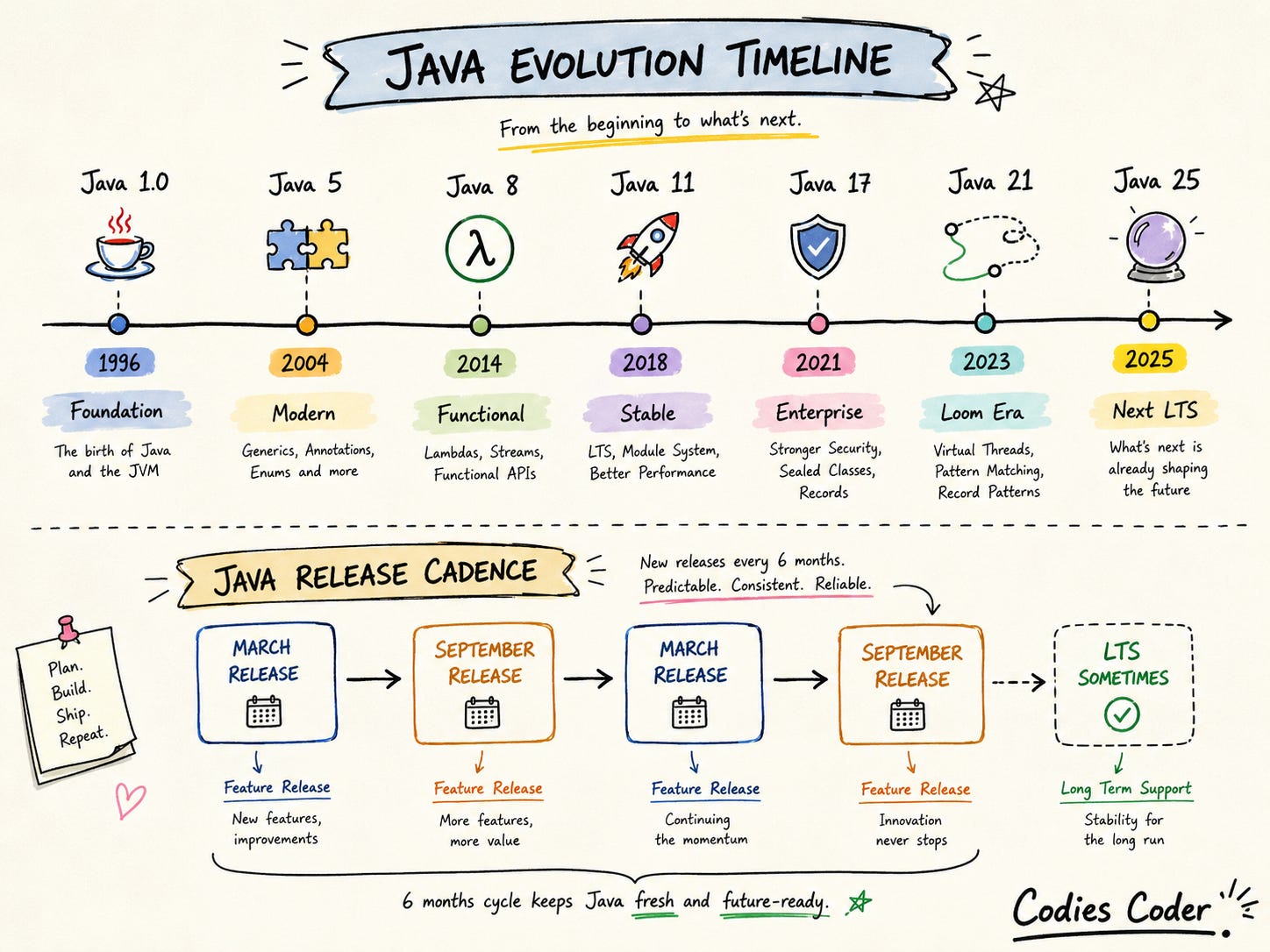
Since then, every release has pushed Java in a clear direction: simpler syntax, better performance, scalable concurrency, and a cleaner platform.
You will notice labels like:
Preview → feature is not final, subject to change
Incubator → experimental API, still being tested
Standard → production-ready and stable
LTS → long-term support
JEPs → JDK Enhancement Proposals
Version-by-version java feature timeline
Java 1.0
Core Features
Introduced the JVM and bytecode execution model to run the same code across platforms
Enabled automatic garbage collection to manage memory without manual deallocation
Built the language around object-oriented design (classes, inheritance, polymorphism)
Provided multithreading support at the language level
Delivered platform independence (WORA — Write Once, Run Anywhere)
Implemented a sandbox-based security model to safely run untrusted code
UI & Distribution
Introduced AWT (Abstract Window Toolkit) for basic GUI development
Added applets to run Java programs inside web browsers
This marked the beginning of Java’s focus on portability and security as core principles, laying the foundation of its runtime model, though it lacked the rich libraries and maturity required for modern application development.
Java 1.1
Core Features
Introduced inner classes for better encapsulation and cleaner event handling
Added JavaBeans component model to enable reusable, tool-friendly components
Introduced JDBC to standardize database access
Improved RMI to support distributed object communication
Added Reflection API to inspect and modify classes at runtime
UI & Event Handling
Introduced delegation event model (AWT) to replace old event handling with a listener-based approach
Platform Enhancements
Improved internationalization (i18n) for global application support
Updated JNI(Java Native Interface) to improve interaction with native code
Introduced JAR format to simplify packaging and distribution
Added signed applets to improve security
JDBC enabled real database-driven applications, which pushed Java into enterprise use. The delegation event model reduced UI complexity and improved maintainability. JavaBeans and JAR improved reuse and deployment, lowering development time. Security improvements increased trust, while internationalization expanded global reach.
Java 1.2
Introduced the platform naming that grouped the language and runtime under J2SE.
Core Improvements
Introduced the Collections Framework
Provided standard data structures (List, Set, Map)
Simplified data handling and improved code maintainability
Added Swing (JFC)
Delivered a more powerful and flexible GUI toolkit
Replaced older AWT limitations
Platform Enhancements
Improved RMI (Remote Method Invocation)
Strengthened security features
Enhanced portability across systems
Introduced and matured **JavaBeans component model
Enhanced Javadoc system
Added package-level documentation
Enabled system-wide documentation
Introduced doclets and richer output formats
The Collections Framework reduced development time and bugs by standardizing data handling, which directly lowered maintenance cost and improved developer productivity. Performance became more predictable due to optimized, reusable data structures. Stronger security features increased trust for enterprise use, while improved portability reduced deployment friction across platforms
Java 1.3
Improved performance with the HotSpot Client VM, HotSpot Server VM, and tuned runtime libraries.
Improved web deployment with applet caching and automatic deployment of optional packages.
Added enterprise interoperability with RMI-IIOP and JNDI.
Strengthened security with RSA signatures, dynamic trust management, and better X.509 certificate support.
Added Java Sound as a standard audio API.
Also improved javac, dynamic proxies, Collections, Swing, debugging APIs, and internationalization.
This is a “make Java faster and more usable” release, not a language rework.
Java 1.4
Added assertions for runtime checks.
Added regular expressions through
java.util.regex.Added NIO with buffers, character-set support, file I/O, scalable network I/O, and better performance.
Added the Logging API and XML processing APIs.
Improved Swing with spinner, formatted text field, drag-and-drop, indeterminate progress bar, scrollable tabs, and better focus handling.
Improved performance and debugging with HotSpot updates, full-speed debugging, and GC logging.
Added chained exceptions and new
Stringmethods:split,matches,replaceAll, andreplaceFirstJava 1.4 is where the platform starts feeling like a serious server and tooling environment, not just a language.
Java 5
Core Language Features
Added generics to provide type safety and remove explicit casting
Added annotations to attach metadata to code for tools and frameworks
Introduced enums as a type-safe way to define constants
Enabled autoboxing and unboxing to convert between primitives and wrapper types automatically
Added varargs to pass variable-length arguments to methods
Introduced enhanced for-loop to simplify iteration over collections and arrays
Added static import to use static members without class qualification
Concurrency & Utilities
Introduced
java.util.concurrentfor high-level concurrency (thread pools, locks, concurrent collections)Added Scanner for easier input parsing
Added Formatter for formatted output (similar to
printf)
Platform Enhancements
Added ProcessBuilder for cleaner subprocess execution than
Runtime.exec.Added the Instrumentation API in
java.lang.instrumentfor runtime bytecode modification by Java agents.Added Class Data Sharing to reduce startup time and footprint by sharing core class metadata across JVMs.
Improved garbage collector ergonomics and server-class machine detection to reduce manual tuning and improve startup behavior.
Collections Framework was enhanced with generics support and extended with new interfaces and implementations (Queue, BlockingQueue, ConcurrentMap, copy-on-write collections, type-safe wrappers).
Java 5 is the real baseline for “modern Java” syntax and concurrency. If you are missing generics and annotations in your mental model, everything above this becomes harder.
Java 6
Expanded Collections with
Deque,BlockingDeque, andNavigableSetAdded JSR 223 scripting support.
Added the Java Compiler API (
JSR 199) and pluggable annotation processing (JSR 269).Added JDBC 4.0, StAX, JAXB 2.0, and JAX-WS 2.0.
Improved Swing with table sorting, filtering, highlighting,
SwingWorker, and text-component printing.Improved runtime performance, startup time, synchronization, and class-file parsing.
Java 6 is the “solidify the platform” release. Less flashy, but important in real systems.
Java 7 — July 28, 2011
Core Language Features (JSR 334 – Project Coin)
Introduced try-with-resources for automatic resource management (
AutoCloseable)Added multi-catch exceptions and improved type checking for rethrowing exceptions.
Introduced diamond operator (
<>) for generic type inferenceAdded strings in switch statements
Added binary literals (
0b1010) and underscores in numeric literals (1_000_000)
NIO.2 (JSR 203 — Major Upgrade)
Introduced
Path,Files, and modern filesystem APIAdded file tree walking
Added file watching (
WatchService)Improved symbolic link and filesystem support
JVM & Runtime Enhancements
Introduced
invokedynamic(JSR 292) for dynamic language supportAdded method handles (
java.lang.invoke)Made G1 Garbage Collector available (experimental)
HotSpot improvements:
Better JIT performance
Startup optimizations
Improved class loading (e.g.,
URLClassLoaderenhancements)
TLS 1.2 support introduced
Unicode 6.0 support
Improved networking APIs (SCTP, SDP support)
Fork/Join framework
Java 7 is where code becomes noticeably cleaner and safer to write, especially for resource handling and filesystem work.
Java 8 (LTS) — March 18, 2014
Core Language Features
Added lambda expressions to pass behavior as data
Added method references to simplify lambda expressions
Added default methods in interfaces to evolve APIs without breaking implementations
Functional & Collections
Added the Streams API for declarative data processing on collections
Integrated streams with the Collections Framework for bulk operations
Core APIs
Added
Optionalto represent nullable values explicitlyAdded the
java.timeAPI for modern date and time handling
Language & Metadata
Added repeating annotations
Added type annotations for stronger type checking and analysis
Platform Features
Added Nashorn JavaScript engine to replace Rhino
Added Compact Profiles to support smaller runtime deployment
If you are writing real-world Java today, Java 8 is the minimum mental baseline. Streams, lambdas,
Optionaland the new date/time API are not optional knowledge anymore.
Java 9 — September 21, 2017
Java 9 delivered the module system (
Project Jigsaw)Core Language Features
Refined Project Coin with small language changes: it allowed effectively final variables as resources in
try-with-resources, supported the diamond operator with anonymous classes in valid cases, added private methods in interfaces, and removed underscore from the legal identifier set.
Platform and Libraries
Introduced the Java Platform Module System. It added modules, modular JARs, JMODs,
jlink, custom runtime images, and module paths. It also split the JDK into modules and removedrt.jar,tools.jar, and the extension mechanism.Added JShell, an interactive REPL for Java.
Added multi-release JARs so one archive can carry version-specific class files.
Added convenience factory methods for collections such as
List.of,Set.of, andMap.of.Added Process API updates through
ProcessHandleand related controls for operating system processes.Added the Platform Logging API and Service so platform classes can log through a pluggable service.
Added More Concurrency Updates, including a publish-subscribe framework and
CompletableFutureenhancements.Added Segmented Code Cache to split compiled code into separate cache segments and improve performance.
Java 9 matters because it starts the modular JDK era. If you maintain large systems, this release affects packaging, runtime images, and dependency boundaries.
Java 10 — March 20, 2018
Core Language Features
Added local-variable type inference with
varfor local variables that have initializers.
Runtime and Platform
Added Application Class-Data Sharing (AppCDS) to archive application classes and improve startup time and memory footprint.
Added a Garbage Collector Interface to isolate GC implementations in HotSpot.
Made G1 full GC parallel to improve worst-case latency.
Added thread-local handshakes so the JVM can act on individual threads without a global safepoint.
Added root certificates in the JDK.
Removed the
javahnative-header generation tool.
Java 10 cut boilerplate with
varand improved startup and GC behaviour with AppCDS and VM runtime changes. It also removedjavah, which pushed native-header generation intojavac.
Java 11 (LTS) — September 25, 2018
Core Language and Tooling Features
Added local-variable syntax for lambda parameters (
var) so you can annotate lambda parameters without writing their types.Added single-file source-code programs so the
javalauncher can run one source file directly.
Core APIs
Standardized the HTTP Client API (
java.net.http) with support for HTTP/2 and WebSocket (JEP 321)Added Unicode 10 support.
Added new String methods:
isBlank,lines,strip,stripLeading,stripTrailing,repeatAdded Files utility methods:
readString,writeString
JVM and Runtime
Added nest-based access control so nested classes can access each other’s private members without bridge methods.
Added dynamic class-file constants.
Added TLS 1.3 support.
Added Flight Recorder for low-overhead event recording and troubleshooting.
Added ZGC as an experimental low-latency garbage collector.
Added Epsilon GC as an experimental no-op garbage collector.
Removals
Removed the Java EE and CORBA modules from the JDK.
Removed the deployment stack: Java Web Start, Java Plugin, Java Control Panel, and applet support.
Removed bundled JavaFX from the JDK.
Stopped offering the JRE and Server JRE as separate downloads.
Java 11 is a very strong production baseline, but migration breaks are real. Do not treat it as “just Java 8 plus extras.”
Java 12 — March 19, 2019
Core Language Features
Added switch expressions (Preview)
Core APIs
Added the JVM Constants API
Added compact number formatting
Added Unicode 11 support
JVM and GC
Enabled default CDS archives
Improved G1 GC with abortable mixed collections
Improved G1 GC to return unused committed memory faster
Added one AArch64 port, Not Two
Added a microbenchmark suite for JVM work
Added Shenandoah: A Low-Pause-Time Garbage Collector (Experimental)
Java 12 gave developers a preview of the next switch syntax, improved startup and memory behaviour, and expanded GC options. It also added lower-level JVM support and runtime tooling for performance work.
Java 13 — September 17, 2019
Core Language Features
Added switch expressions (2 Preview).
Added text blocks for multi-line string literals and cleaner embedded text (Preview).
JVM and Runtime
Added dynamic CDS archives to archive application classes at the end of execution.
Added ZGC memory uncommit to return unused heap memory to the operating system.
Reimplemented the legacy Socket API for
SocketandServerSocket.
Java 13 improved startup and memory behaviour, modernized socket internals, and let developers test two language features before final release. It was a feature release, not an LTS baseline.
Java 14 — March 17, 2020
Core Language Features
Switch expressions - (Standard)
Records - (Preview)
Pattern matching for
instanceof- (Preview)Text blocks - (Second Preview)
Runtime and Tools
Helpful NullPointerExceptions
Packaging Tool - (Incubator)
JFR Event Streaming
NUMA-Aware Memory Allocation for G1
Non-Volatile Mapped Byte Buffers
ZGC on macOS - (Experimental)
ZGC on Windows - (Experimental)
Foreign-Memory Access API - (Incubator)
Removals
Pack200 tools and API removed.
Deprecate the Solaris and SPARC Ports.
Remove the Concurrent Mark Sweep (CMS) Garbage Collector.
Deprecate the ParallelScavenge + SerialOld GC combination.
Java 14 made switch expressions standard, and introduced records and pattern matching for
instanceofas preview features. It also kept text blocks in preview with refinements.It also brought tooling/runtime work such as JFR event streaming, and the migration guide later notes that
jpackagehad already entered as an incubated tool in this era.This is where the modern data-modeling path starts, but records are still not final here.
Java 15 — September 15, 2020
Core Language Features
Text Blocks - (Standard)
Sealed Classes - (Preview)
Pattern Matching for
instanceof- (Second Preview)Records - (Second Preview)
Core APIs and JVM
Edwards-Curve Digital Signature Algorithm (EdDSA)
Hidden Classes
Reimplemented the legacy
DatagramSocketAPIForeign-Memory Access API - (Second Incubator)
Garbage Collection and Runtime
ZGC: A Scalable Low-Latency Garbage Collector - (Production Feature)
Shenandoah: A Low-Pause-Time Garbage Collector - (Production Feature)
Removals and Deprecations
Removed Nashorn JavaScript Engine
Removed Solaris and SPARC ports
Deprecated RMI Activation for removal
Disabled and deprecated biased locking
This release is a major step toward modern Java style.
Java 16 — March 16, 2021
Core Language Features
Records - (Standard)
Pattern matching for
instanceof- (Standard)Sealed Classes - (Second Preview)
Core APIs and Tooling
Vector API - (Incubator)
Foreign Linker API - (Incubator)
Foreign-Memory Access API - (Third Incubator)
Packaging Tool
Runtime and JVM
Unix-Domain Socket Channels.
Warnings for Value-Based Classes.
ZGC: Concurrent Thread-Stack Processing.
Elastic Metaspace.
Strongly Encapsulate JDK Internals by Default.
Alpine Linux Port
Windows/AArch64 Port
Records are safe to use here, and Java 16 is where the Panama path starts looking real.
Java 17 (LTS) — September 14, 2021
Core Language Features
Sealed Classes - (Standard)
Pattern Matching for
switch- (Preview)Restore Always-Strict Floating-Point Semantics
Core APIs and Security
Enhanced Pseudo-Random Number Generators
Context-Specific Deserialization Filters
Deprecate the Applet API for Removal
Deprecate the Security Manager for Removal
JVM and Runtime
Strongly Encapsulate JDK Internals
Remove RMI Activation
Remove the Experimental AOT and JIT Compiler
Platform and Graphics
New macOS Rendering Pipeline for Java 2D API
macOS/AArch64 Port
Incubator APIs
Foreign Function & Memory API - (Incubator)
Vector API - (Second Incubator)
This is the clean modern baseline for enterprise Java. If a team is not on 17 or 21, the migration story is usually more important than the feature list.
Java 18 — March 22, 2022
Core Language Features
UTF-8 as Default Charset
Pattern Matching for
switch- (Second Preview)
API & Tooling Enhancements
Simple Web Server
Code Snippets in JavaDoc
Reimplement Core Reflection with Method Handles
Internet-Address Resolution SPI
Incubator APIs
Vector API - (Third Incubator)
Foreign Function & Memory API - (Second Incubator)
Deprecation
Deprecate Finalization for Removal
This is a polish release, not a strategic production target.
Java 19 — September 20, 2022
Core Language Features
Record Patterns - (Preview)
Pattern Matching for
switch- (Third Preview)
Concurrency (Project Loom)
Virtual Threads - (Preview)
Structured Concurrency - (Incubator)
Native Interoperability (Project Panama)
Foreign Function & Memory API - (Preview)
Performance & Vectorization
Vector API - (Fourth Incubator)
Platform & Portability
Linux/RISC-V Port
Loom becomes visible here, but nothing in this release should be treated as stable concurrency doctrine yet.
Java 20 — March 21, 2023
Core Language Features
Record Patterns - (Second Preview)
Pattern Matching for
switch- (Fourth Preview)
Concurrency (Project Loom)
Virtual Threads - (Second Preview)
Structured Concurrency - (Second Incubator)
Scoped Values - (Incubator)
Native Interoperability (Project Panama)
Foreign Function & Memory API - (Second Preview)
Performance & Vectorization
Vector API (Fifth Incubator)
This is stabilization, not finalization.
Java 21 (LTS) — September 19, 2023
Core Language & APIs
Record Patterns - (Standard)
Pattern Matching for
switch- (Standard)Sequenced Collections - (Standard)
Key Encapsulation Mechanism (KEM) API - (Standard)
String Templates - (Preview)
Unnamed Patterns and Variables - (Preview)
Unnamed Classes and Instance Main Methods - (Preview)
Concurrency (Project Loom)
Virtual Threads - (Standard)
Structured Concurrency - (Preview)
Scoped Values - (Preview)
Native Interoperability (Project Panama)
Foreign Function & Memory API - (Third Preview)
Runtime, Performance & JVM
Generational ZGC - (Standard)
Vector API - (Sixth Incubator)
Prepare to Disallow the Dynamic Loading of Agents - (Standard)
Deprecate the Windows 32-bit x86 Port for Removal - (Deprecated)
This is the modern concurrency and pattern-matching baseline. For new production work, 21 is the safest modern target if your stack is ready for it.
Java 22 — March 19, 2024
Core Language & APIs
Unnamed Variables & Patterns - (Standard)
Foreign Function & Memory API - (Standard)
Statements before
super(...)- (Preview)String Templates - (Second Preview)
Implicitly Declared Classes and Instance Main Methods - (Second Preview)
Class-File API - (Preview)
Stream Gatherers - (Preview)
Launch Multi-File Source-Code Programs - (Standard)
Concurrency (Project Loom)
Structured Concurrency → (Second Preview)
Scoped Values → (Second Preview)
Runtime & Performance
Region Pinning for G1 → (Standard)
Vector API → (Seventh Incubator)
Panama crosses a major line here, but most of the “new syntax” story is still in preview.
Java 23 — September 17, 2024
Core Language & APIs
Primitive Types in Patterns,
instanceof, andswitch- (Preview)Module Import Declarations - (Preview)
Flexible Constructor Bodies - (Second Preview)
Implicitly Declared Classes and Instance Main Methods - (Third Preview)
Class-File API - (Second Preview)
Stream Gatherers - (Second Preview)
Markdown Documentation Comments - (New)
Vector API - (Eighth Incubator)
Concurrency (Project Loom)
Structured Concurrency - (Third Preview)
Scoped Values - (Third Preview)
Runtime and JVM
ZGC Generational Mode is now the default.
sun.misc.Unsafememory-access methods are deprecated for removal.Thread.suspend(),Thread.resume(),ThreadGroup.suspend(),ThreadGroup.resume(), andThreadGroup.stop()were removed.javacannotation processing is disabled by default unless you enable it explicitly.String Templates were withdrawn and do not ship in JDK 23.
Java 23 is a heavy experimentation release. Read it for direction, not for stability.
Java 24 — March 18, 2025
Core Language & APIs
Primitive Types in Patterns,
instanceof, andswitch- (Second Preview)Module Import Declarations - (Second Preview)
Flexible Constructor Bodies - (Third Preview)
Simple Source Files and Instance Main Methods - (Fourth Preview)
Class-File API - (Standard)
Stream Gatherers - (Standard)
Key Derivation Function API → (Preview)
Linking Run-Time Images without JMODs
Quantum-Resistant Module-Lattice-Based Key Encapsulation Mechanism
Quantum-Resistant Module-Lattice-Based Digital Signature Algorithm
Concurrency (Project Loom)
Structured Concurrency - (Fourth Preview)
Scoped Values - (Fourth Preview)
Synchronize Virtual Threads without Pinning - (New)
Runtime & JVM
Ahead-of-Time Class Loading & Linking
Late Barrier Expansion for G1
ZGC: Remove the Non-Generational Mode - (Change)
Vector API - (Ninth Incubator)
Restrict the use of JNI (warnings introduced) - (Change)
Remove the Windows 32-bit x86 Port - (Removed)
Deprecate the 32-bit x86 Port for Removal - (Deprecated)
Warn upon Use of Memory-Access Methods in
sun.misc.Unsafe- (Change)Permanently Disable the Security Manager - (Removed)
Experimental
Generational Shenandoah - (Experimental)
Compact Object Headers - (Experimental)
This release is important for JVM internals and startup work, not because you should adopt every new preview feature.
Java 25 (LTS) — September 16, 2025
Core Language & APIs
Primitive Types in Patterns,
instanceof, andswitch- (Third Preview)Module Import Declarations - (Standard)
Compact Source Files and Instance Main Methods - (Standard)
Flexible Constructor Bodies - (Standard)
Stable Values - (Preview)
Concurrency (Project Loom)
Structured Concurrency - (Fifth Preview)
Scoped Values - (Standard)
Security & Cryptography
PEM Encodings of Cryptographic Objects - (Preview)
Key Derivation Function API - (Standard)
Runtime & JVM
Remove the 32-bit x86 Port - (Removed)
Vector API - (Tenth Incubator)
Compact Object Headers - (Standard)
Ahead-of-Time Command-Line Ergonomics
Ahead-of-Time Method Profiling
JFR Cooperative Sampling - (Standard)
JFR Method Timing & Tracing - (Standard)
Generational Shenandoah - (Standard)
Experimental
JFR CPU-Time Profiling - (Experimental)
This is the next enterprise baseline after 21. Treat it as a serious candidate for new greenfield work once your libraries and platform support it.
Java 26 — March 17, 2026
Core Language & APIs
Primitive Types in Patterns,
instanceof, andswitch→ (Fourth Preview)
Libraries & Security
HTTP/3 for the HTTP Client API → (Standard)
PEM Encodings of Cryptographic Objects → (Second Preview)
Lazy Constants → (Second Preview)
Concurrency (Project Loom)
Structured Concurrency → (Sixth Preview)
Runtime & JVM
Prepare to Make Final Mean Final → (Change)
Remove the Applet API → (Removed)
Ahead-of-Time Object Caching with Any GC → (Standard)
G1 GC: Improve Throughput by Reducing Synchronization → (Standard)
Vector API → (Eleventh Incubator)
Java 26 is a feature bridge, not an LTS target. It is useful if you care about the newest runtime, security, and performance work.
Java 27 — September 2026
Post-Quantum Hybrid TLS → Planned (JEP)
Not GA yet as of now. OpenJDK already publishes JDK 27 early-access builds, and the draft release notes say the contents are still subject to change. The draft notes currently mention post-quantum hybrid key exchange for TLS 1.3 as a feature under consideration.
Major projects in OpenJDK
Do you know someone who loves engineering or has a curiosity for tech? 🤔
Why not share the joy of simplifying complex ideas with them? Forward this newsletter and spread the knowledge—learning is always better when it’s shared! 🚀